
Last Updated: November 12, 2026
Quick Summary
Furnish a coastal living room by picking a three-color palette of sun-washed neutrals, blue and white, and one accent before you shop. Then buy comfortable seating first, add natural materials like light wood, rattan, jute, and linen, and mix no more than three materials.
- Start with three colors and no more: a base, a second, and one accent.
- A sofa should take up about two-thirds of the wall it sits against.
- Leave 36 inches for main walkways and 18 inches between sofa and coffee table.
- Mix no more than three materials, such as wood, rattan, and linen.
- Buy anchor pieces together and split accents like pillows and art for later.
Table of Contents
- 1. Start With the Coastal Living Room Palette and a Plan
- 2. Choose the Sofa and Comfortable Seating First
- 3. Add Coffee Tables, Side Tables, and Natural Materials
- 4. Small Coastal Living Room Furniture Ideas for Beginners
- 5. Modern Coastal Living Room Furniture Without the Nautical Theme
- 6. Coastal Living Room Furniture Sets: What to Buy Together and What to Split
- 7. Measure, Arrange, and Pick a Downloadable Plan
- Frequently Asked Questions
1. Start With the Coastal Living Room Palette and a Plan
A coastal living room is a light-filled space built on sun-washed neutrals, blue and white accents, and natural textures that make the room feel calm and airy. The look works because it stays simple: a soft base, one or two coastal colors, and materials like linen, rattan, and light wood.
Pick the palette first, then buy furniture that fits it. Skipping this step is the most common beginner mistake, and it usually ends with a room that feels busy instead of calm.
Start with three colors and no more:
- Base: warm white, cream, or Sea Salt
- Second: soft blue, navy, or pale gray
- Accent: sand, driftwood, or a touch of coral
Write the colors down before you shop. Design guidance from the basics of color theory from the Smithsonian's design resources backs this up: fewer colors, repeated well, read as calm. More colors read as clutter.
Sun-Washed Neutrals and Blue and White
Sun-washed neutrals are colors that look faded by the sun: oyster white, pale sand, washed gray, and muted Sea Salt. Pair them with blue and white and you get the classic coastal look without a single seashell.
Keep the mix simple. Use the neutral on walls and big pieces. Use blue and white on pillows, throws, and art. Then repeat one accent color three times across the room so the eye has somewhere to land.
2. Choose the Sofa and Comfortable Seating First
Comfortable seating decides how the room works, so buy it before anything else. A linen or slipcovered sofa in cream, white, or pale gray anchors the space. Add two chairs in a woven or wood frame to bring in texture, and keep the lines clean.
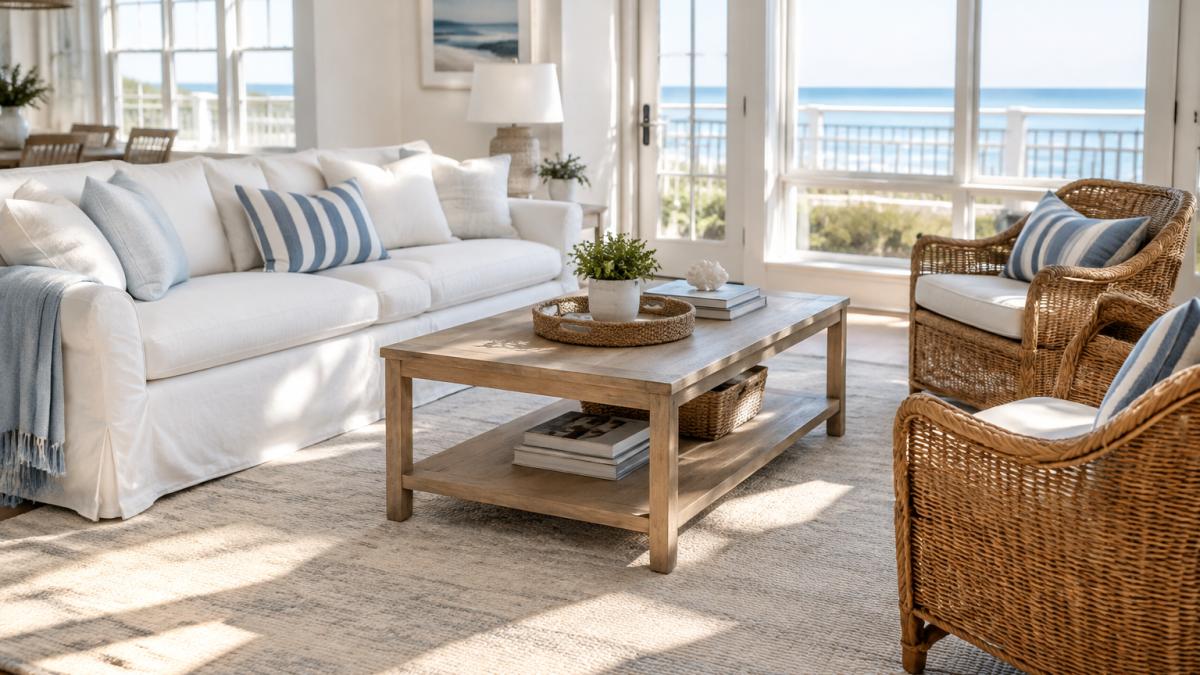
Measure the longest wall, then leave at least 36 inches for walkways. A sofa should take up about two-thirds of the wall it sits against. Anything longer crowds the room.
Slipcovered upholstery is the practical pick for beginners. It hides everyday wear and washes clean, which matters in homes with kids or pets. If you want a ready-made starting point, our coastal living room ready-made room design pairs a sofa and seating in one coordinated plan.
3. Add Coffee Tables, Side Tables, and Natural Materials
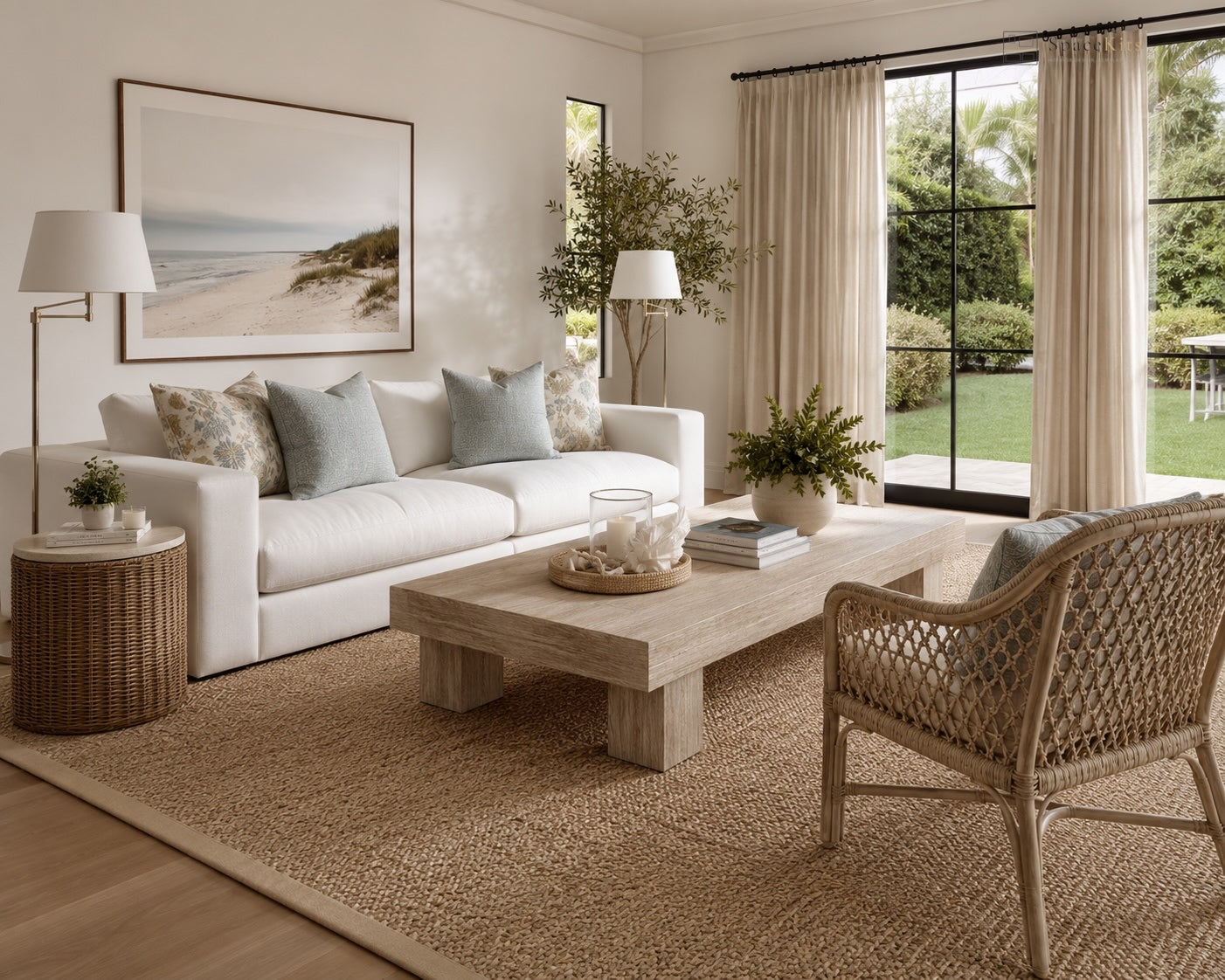
Natural materials carry the coastal look more than any single piece of furniture. Light wood, rattan, jute, and linen add warmth and texture without adding color. A round light wood coffee table softens a boxy room. Woven side tables and a jute rug ground the seating area.
Follow one rule: mix no more than three materials. Too many textures fight each other. Wood plus rattan plus linen is plenty.
For accent pieces, choose a few and stop:
- Two woven baskets for blankets
- One large piece of blue and white art
- A linen throw and two textured pillows
A common mistake is buying every coastal accent at once. Buy slowly. The room will look better with fewer, larger pieces than with a shelf full of small ones.
4. Small Coastal Living Room Furniture Ideas for Beginners
Small coastal living room furniture ideas for beginners come down to scale, not style. A small room needs slimmer frames, lighter colors, and furniture that lifts off the floor. Bulky pieces make a tight space feel tighter, no matter how good the palette is. Most guides stop at that sentence. The useful version is a set of measurable moves you can apply to a 10-by-12-foot apartment, a rental with beige carpet, or an inland house that has never seen a beach.
Start with the numbers. Measure the longest wall and the distance between doorways, then write those figures down before you shop. A sofa should run about two-thirds of the wall it sits against, so a 9-foot wall takes a sofa in the 72- to 84-inch range. Leave 36 inches for main walkways and 18 inches between the sofa and coffee table.
Try these moves:
- Pick a sofa with exposed legs so the floor shows through; a 6- to 8-inch leg height reads lighter than a skirted base
- Use a round or oval coffee table to ease tight walkways
- Choose a glass or light wood side table over a solid block
- Hang curtains high and wide, rod 2 to 4 inches below the ceiling and 6 to 10 inches past each side of the window, to make walls feel taller
- Keep the palette light so the room reads bigger, and repeat one blue accent three times rather than scattering five colors
- Swap a full-size rug for a 5-by-8 or 6-by-9 that leaves 12 to 18 inches of floor visible around the seating
Renters can use every one of these ideas. None of them need paint or a permanent change. If your lease forbids wall anchors, lean a large mirror or a piece of blue and white art against the wall instead of hanging it, and use tension rods or removable adhesive hooks for curtains.
Inland and non-beach homes need one adjustment: lean harder on light, texture, and a single blue accent, and skip anything that reads as a souvenir. A city apartment with a clean-lined cream sofa, a light wood table, and one navy pillow still reads coastal. A beach house can carry more woven texture and a slightly sandier palette. The style travels; the motifs do not.
Watch out: buying a loveseat to "save space" often backfires, because a 50- to 60-inch loveseat seats two people and leaves no room for a chair, while a slim 72-inch sofa plus one woven chair seats three in the same footprint.
If you are furnishing a small space from scratch, our beginner DIY design guide walks through the full project step by step.
5. Modern Coastal Living Room Furniture Without the Nautical Theme
Modern coastal living room furniture drops the theme and keeps the feeling. Skip the anchors, rope, and sign art. Keep the light palette, clean-lined furniture, and natural textures, and the room still reads coastal.
This version suits many homes. It fits a city apartment as well as a beach house. A clean-lined sofa, a light wood table, and one blue accent do the work.
What most guides miss is that modern coastal and beach-inspired are not the same look. Beach-inspired leans on motifs. Modern coastal leans on light, texture, and calm. Choose modern coastal if you want a timeless room you will not redecorate in two years.
Browse our full coastal collection to see non-theme pieces that fit a modern look.
6. Coastal Living Room Furniture Sets: What to Buy Together and What to Split
Coastal living room furniture sets save time, but you do not have to buy every piece at once. Buy the anchor pieces together so the scale and palette match. Split the rest so you can add personality over time.
| Buy Together | Split and Add Later |
|---|---|
| Sofa and chairs | Accent pillows and throws |
| Coffee table and rug | Art and wall decor |
| Side tables | Baskets and small accents |
| Main light fixture | Lamps and candles |
Buying the anchor pieces first can reduce guesswork on sizing and color. Then you can fill in accents as budget allows.
If you are matching paint to furniture you already own, our guide on picking paint colors that match your furniture covers the pairing rules.
7. Measure, Arrange, and Pick a Downloadable Plan
Measure the room before you move a single piece of furniture. Note the wall lengths, door swings, window placement, and the height of any sill or radiator that furniture has to clear. Then mark the walkways: 36 inches for main paths, 18 inches between a sofa and coffee table, and 24 to 30 inches between a coffee table and a TV or fireplace if people walk through that gap.
Here is the order that works for beginners:
- Draw the room to scale on graph paper, one square per foot, and mark doors, windows, and outlets.
- Pick the focal point, a fireplace, a TV, or a view, and face the main seating toward it.
- Place the sofa first, then the coffee table, then chairs, then side tables, then the rug.
- Tape the footprint on the floor with painter's tape and live with it for a day before you buy.
For layout, start with the seating facing the room's focal point. If you need more help, see our guide on how to arrange furniture in an open concept living room.
Rug sizing is where most beginners guess. The front legs of the sofa and chairs should sit on the rug, which usually means an 8-by-10 in a standard room and a 9-by-12 in a large one. A rug that floats in the middle of the seating area makes the room feel smaller, not cozier.
Then get a plan you can follow. SpaceKits offers instant downloadable room templates created by licensed interior designers. Each kit includes floor plans, color codes, mood boards, and clickable shopping lists, so you skip the guesswork and start with a layout that already works. You can follow the plan exactly or swap furniture and colors to suit your taste. The Shoreline Living coastal kit is $22, and the full collection of 49 templates across 10 rooms is $299.
Watch out: a plan drawn without door swings and outlet locations can look fine on paper and still fail in the room.
A coastal living room does not need a big budget or a designer. It needs a plan, the right order, and a little patience. Get started with SpaceKits to plan a calm, light-filled room.
Frequently Asked Questions
What furniture should you choose first when designing a coastal living room?
Start with the sofa. It is the largest purchase, it sets the color and texture direction for everything else, and seating drives the layout. Pick a clean-lined sofa in a sun-washed neutral such as off-white, sand, or light gray, ideally in linen or a slipcovered fabric. Once the sofa is placed, measure the walkway around it before buying a coffee table, then add side tables and accent chairs. Buying in that order keeps you from spending on pieces that do not fit the room.
How do you make a small coastal living room furniture layout work?
Keep the footprint light and the sightlines open. Choose a sofa with exposed legs rather than a skirted base so floor space stays visible, use a round or oval coffee table to soften tight walkways, and swap bulky armchairs for woven or slatted chairs you can see through. Leave at least 18 inches between the sofa and coffee table and 30 to 36 inches for main walking paths. Wall-mounted shelves and a single tall plant add height without eating floor area.
What colors and materials work well for coastal living room furniture?
Sun-washed neutrals carry the look: white, cream, sand, driftwood gray, and soft Sea Salt green, with blue and white as accents rather than wall-to-wall color. For materials, light wood, rattan, cane, jute, and linen do most of the work because they add texture without weight. Keep painted furniture to one or two pieces and add colorful accents through pillows, art, and a rug so the palette stays easy to change later.
Do you need to live near the beach to use coastal living room furniture ideas?
No. Coastal style is about light, texture, and a calm palette, not proximity to water. Inland homes and rentals get the same effect with a linen sofa, light wood tables, woven storage baskets, and blue and white accents. Renters can skip paint and permanent fixtures entirely and rely on slipcovers, removable wallpaper, and freestanding furniture. A downloadable room plan with a floor plan and shopping list makes the look achievable without a designer.
